
Augmented Reality for Professional Training: Opportunities, Challenges and Prospects for the Future of Work
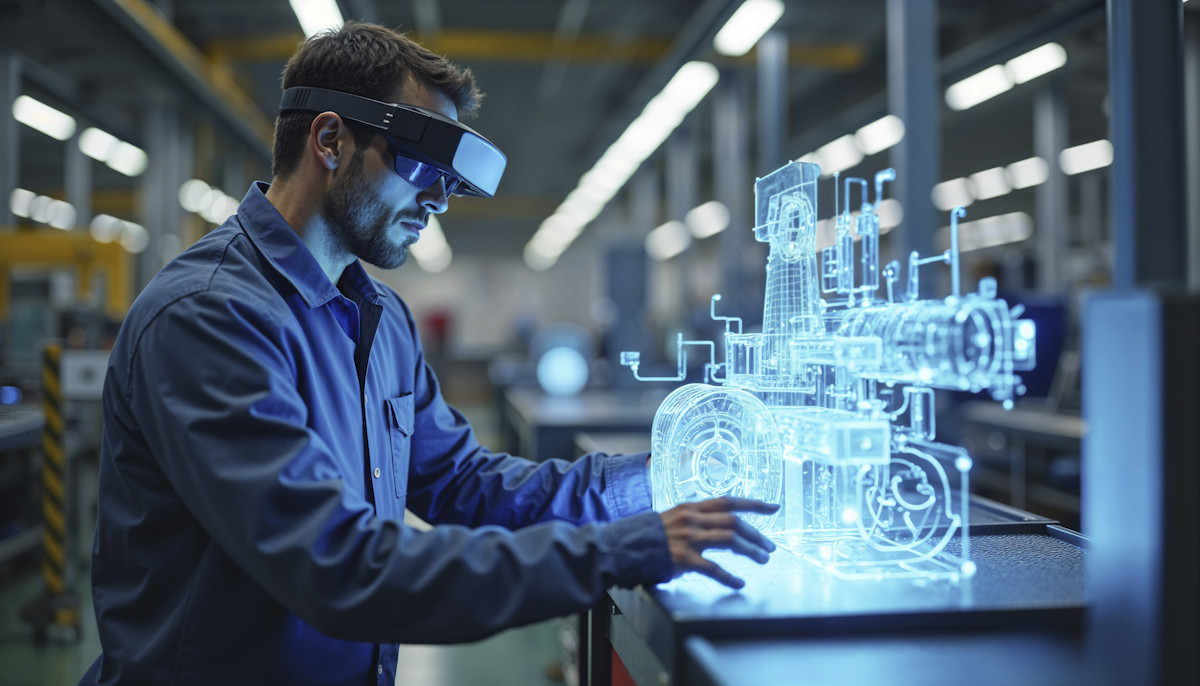
Over the last ten years, Augmented Reality (AR) has moved from the world of gaming and experiential marketing to workshops, hospitals, construction sites and vocational training classrooms. Today, it is no longer just a niche technology, but an educational and operational tool that is transforming the way we learn, work and certify our skills throughout our working lives.
In a context marked by digital transition, a shortage of technical skills and a constant need for updating, AR offers a concrete answer to a very clear question: how to make training more practical, effective, safe and recognisable, while maintaining sustainable costs for businesses, training institutions and workers.
1. Why AR has become strategic in training
1.1 From theory to immersive practice
Traditional training is often based on manuals, slides, videos and lectures. These tools are still useful, but they have obvious limitations when it comes to:
- teaching complex manual skills;
- simulating risky situations (safety, health, emergencies);
- reducing operational errors by new recruits;
- ensuring continuous, flexible and modular training.
Augmented Reality allows contextual digital information (text, icons, arrows, 3D animations, videos, checklists) to be superimposed on the real environment. By wearing a headset or using a tablet/smartphone, learners no longer have to ‘imagine’ the procedure: they see and experience it directly on the machine, simulator, anatomical model or real system.
This transition from theory to immersive practice improves understanding, reduces learning time and increases motivation, because training is closer to the actual work experience.
1.2 Measurable effectiveness: retention and performance
Several studies on AR and VR in training highlight three recurring elements:
- Greater content retention: when users interact with objects and scenarios, long-term memory is stimulated more than simply reading or listening.
- Reduction in operational errors: thanks to step-by-step instructions and immediate feedback, errors in the early stages of job placement are significantly reduced.
- Better transfer to the real world: training in simulated but realistic environments makes it easier to transfer what has been learned to the workplace.
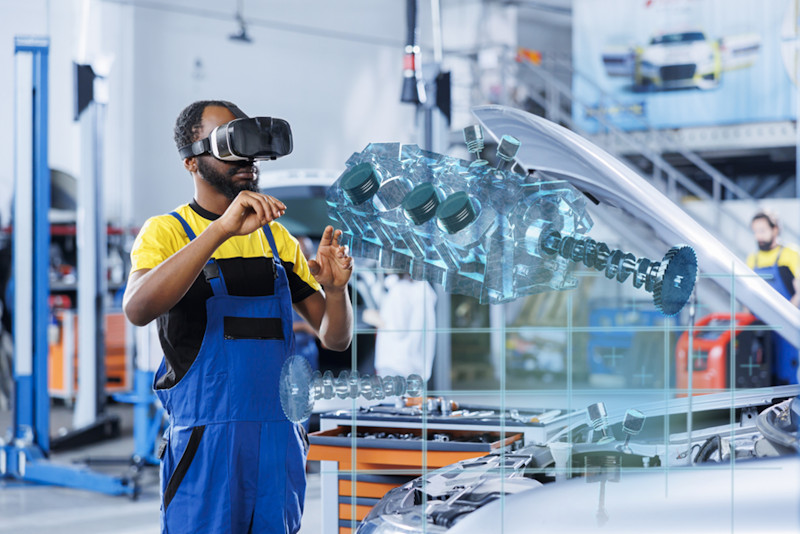
In the industrial sector, experiments conducted on assembly and maintenance lines show error reductions of more than 20–25% and faster execution times, especially for less experienced workers. In the healthcare sector, the use of AR for standardised procedures helps to improve adherence to protocols and reduce the risk of omissions.
2. Realistic simulations and safe learning
One of the most obvious advantages of AR in professional training is the ability to recreate complex or potentially dangerous situations without exposing participants to real risks.
2.1 Industrial sector and maintenance
In factories, energy sites and production plants, operators can:
- view contextual instructions directly on the machinery;
- practise dealing with simulated faults;
- follow guided preventive maintenance procedures;
- learn lockout/tagout procedures, safety procedures and final checks.
This allows workers to make mistakes, repeat and try again without halting production or compromising safety.

2.2 Healthcare, emergency and highly complex areas
In healthcare and emergency management, AR allows you to:
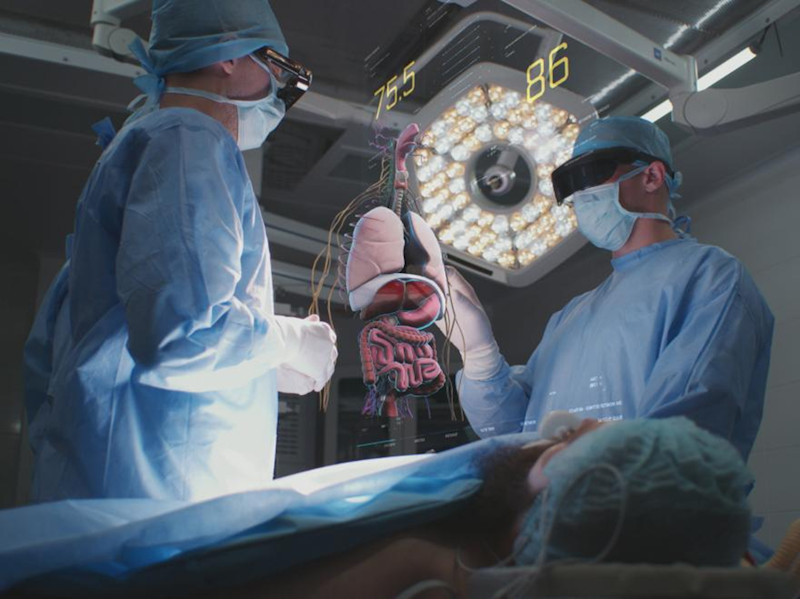
- visualise graphic overlays on anatomical models;
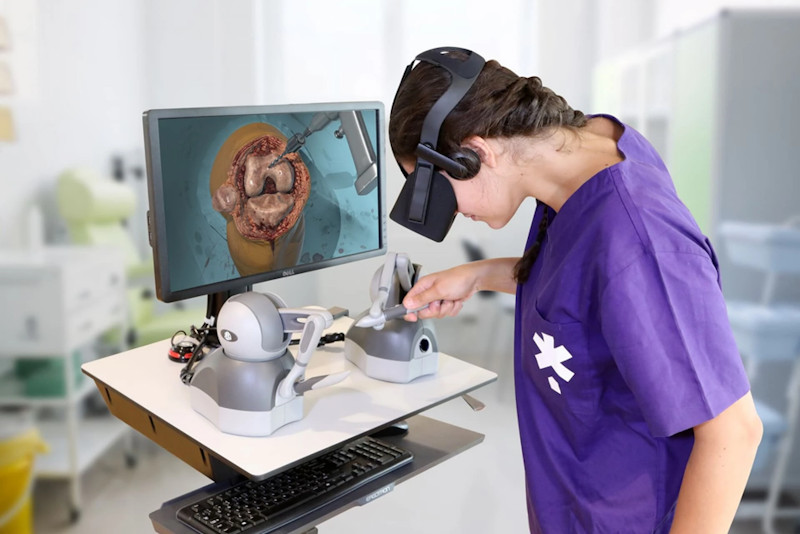
- simulate complex medical and nursing procedures;
- train rescue teams on emergency scenarios, disasters and accidents;
- test protocols and communication between operators under controlled stress conditions.
This allows for an increase in the number of hours of simulated practice without burdening departments or putting patients at risk.
3. Personalisation, adaptability and learning in the workplace
AR is not just about ‘viewing 3D content’: its true potential emerges when it is integrated with progress tracking systems, data analysis and adaptive learning models.
3.1 Personalised learning paths
By collecting performance data (execution times, errors, repeated steps, requests for help), it is possible to:
- adapt the difficulty level of exercises;
- re-propose modules targeting weak skills;
- suggest vertical paths for specific roles (e.g. senior maintenance technician, line technician, quality control technician).
AR thus becomes a tool for building personalised training paths that better respond to the real needs of the worker and the organisation.
3.2 Work-Based Learning and ‘real-time instructions’
Another key element is the possibility of providing training directly in the workplace, integrating it into the operational flow. AR can, for example:
- show the operator which component to check;
- suggest the correct sequence of actions;
- highlight critical areas or risk points;
- automatically verify the execution of a step (using sensors, computer vision, user input).
In this way, the distinction between ‘training time’ and ‘working time’ becomes much more blurred: you learn while you work and work while you learn, with a view to continuous learning.
4. The key issue of certification: micro-credentials and European registers
The spread of AR in training raises a key question for businesses and workers: how can the skills acquired through AR courses be recognised and put to use?
4.1 Micro-credentials and skills recognition
In recent years, the paradigm of micro-credentials has been gaining ground: digital certificates that certify specific and limited skills (e.g. ‘basic maintenance of plant X with AR support’ or ‘safety protocol Y in an industrial environment’). These micro-credentials:
- are modular and cumulative;
- can be linked to the European Qualifications Framework (EQF);
- are easily shareable with employers and digital platforms (e.g. e-portfolios).
Some European projects in the field of vocational training are experimenting with the integration of AR experiences, objective assessment systems and digital micro-credential registers, with the aim of facilitating worker mobility and the recognition of skills between different countries and sectors.
One such project is ours: “Training registry of the Modern Business Services sector,” which has created this type of solution (a registry of training services supported by VR and AR solutions).
We encourage you to check it out at: https://mbssapp.vccsystem.eu/en.
4.2 Registers and quality standards
For AR-based training experiences to be truly recognised, it is necessary to:
- define minimum quality standards for courses using AR;
- build European registers or catalogues of validated pathways;
- harmonise the description of skills in line with European systems (EQF, ESCO, etc.).
The creation of European registers of courses – indicating methodologies, technologies used, learning outcomes and assessment systems – represents a significant step towards transparent standardisation of AR-supported training, increasing the confidence of businesses and workers.
5. The strategic role of trainers and instructional designers
Many imagine AR as a ‘plug and play’ solution where you simply put on a headset to automatically receive effective training. In reality, the quality of the experience depends largely on pedagogical design.
5.1 From traditional trainer to ‘learning experience designer’
The use of AR requires hybrid skills:
- knowledge of instructional design principles;
- the ability to select the most suitable content for immersive use;
- sensitivity in balancing information to avoid cognitive overload;
- collaboration with developers, graphic designers and UX experts.
The trainer increasingly becomes an ‘architect of learning experiences’, capable of integrating classroom teaching, AR exercises, group discussions, individual reflection and assessment.
5.2 Essential guidelines for designing AR training courses
Some basic principles:
- Start with learning outcomes, not technology. First define the skills to be developed, then decide if and how to use AR.
- Use AR only where it adds value: not everything has to be immersive. AR is particularly useful for complex procedures, three-dimensional spaces and interactive scenarios.
- Limit visual noise: too many overlapping elements can confuse the learner. Clear, progressive and ‘clean’ interfaces are better.
- Provide feedback and evaluation: the AR platform should allow you to collect data, suggest improvements and document progress.
- Integrate debriefing sessions: after the immersive experience, it is useful to discuss what happened in a group, interpret mistakes and successes, and link the simulation to real practice.
6. Challenges, limitations and open questions
Despite its great potential, the widespread adoption of AR in professional training still faces several obstacles:
- Start-up costs: although falling, headsets, software licences and content development represent a significant investment, especially for small organisations.
- Rapid obsolescence: hardware and platforms evolve quickly, requiring continuous updates.
- Cultural resistance: both workers and trainers may be wary of technologies perceived as ‘toys’ or as a threat to professionalism.
- Accessibility and inclusion: not all learners tolerate headsets well; alternatives and adaptations must be provided for those with specific needs.
- Privacy and data protection: AR can collect a lot of information about behaviour, timing and performance; great care must be taken in the ethical and regulatory management of this data.
Addressing these critical issues requires support policies, training programmes for trainers and a clear strategic vision on the part of public bodies, businesses and education systems.
7. Future prospects: integration with AI, the metaverse and hybrid working
Looking ahead to the coming years, AR in vocational training seems set to:
- increasingly integrate with artificial intelligence to provide digital tutors, predictive analytics and personalised suggestions;
- interact with shared virtual environments (metaverse, digital twin) for collaborative simulations and team training;
- support the spread of hybrid working and remote mentoring, allowing senior experts to guide younger colleagues remotely via AR interfaces.
In this scenario, the experiences already gained in European pilot projects represent a valuable wealth of good practices, replicable models and field-tested tools that can inspire new initiatives and policies for the future of work.
8. Conclusions
Augmented Reality is not just a technological fad: it is one of the factors that can profoundly redefine vocational training, making it:
- closer to the reality of work;
- safer, thanks to simulations;
- more effective, thanks to immersive practice;
- more personalised, thanks to data and adaptability;
- more recognisable, thanks to micro-credentials and quality registers.
The challenge for the coming years will be to transform experiments into established standards, ensuring that AR and immersive technologies become an accessible opportunity for everyone: businesses, training institutions, young and adult workers, in urban contexts and in more peripheral areas.
References:
- Azuma, R. T. (2017). A Survey of Augmented Reality. Presence: Teleoperators & Virtual Environments, 6(4), 355–385.
- Bacca, J., Baldiris, S., Fabregat, R., Kinshuk, & Graf, S. (2018). Augmented Reality Trends in Education: A Systematic Review. Educational Technology & Society, 21(4), 133–151.
- European Centre for the Development of Vocational Training (CEDEFOP). (2020). Digital Skills and the Future of Work in Europe.
- OECD. (2021). The Digital Learning Compass: New Pedagogies in AR/VR Education.
- UNESCO. (2023). Immersive Technologies in Education: Opportunities and Policy Recommendations.